

Crowns vs Veneers vs Overlays — Material Choice Is a Mechanics Decision
The question "crown or veneer?" sounds like an aesthetic decision. It isn't. The distinction between a crown, a veneer, and an overlay is first and foremost a mechanical one - about how much tooth structure remains, where bite forces travel, and which material can survive them reliably over ten or twenty years.
Crown, Veneer, or Overlay: Which Removes Less Tooth?
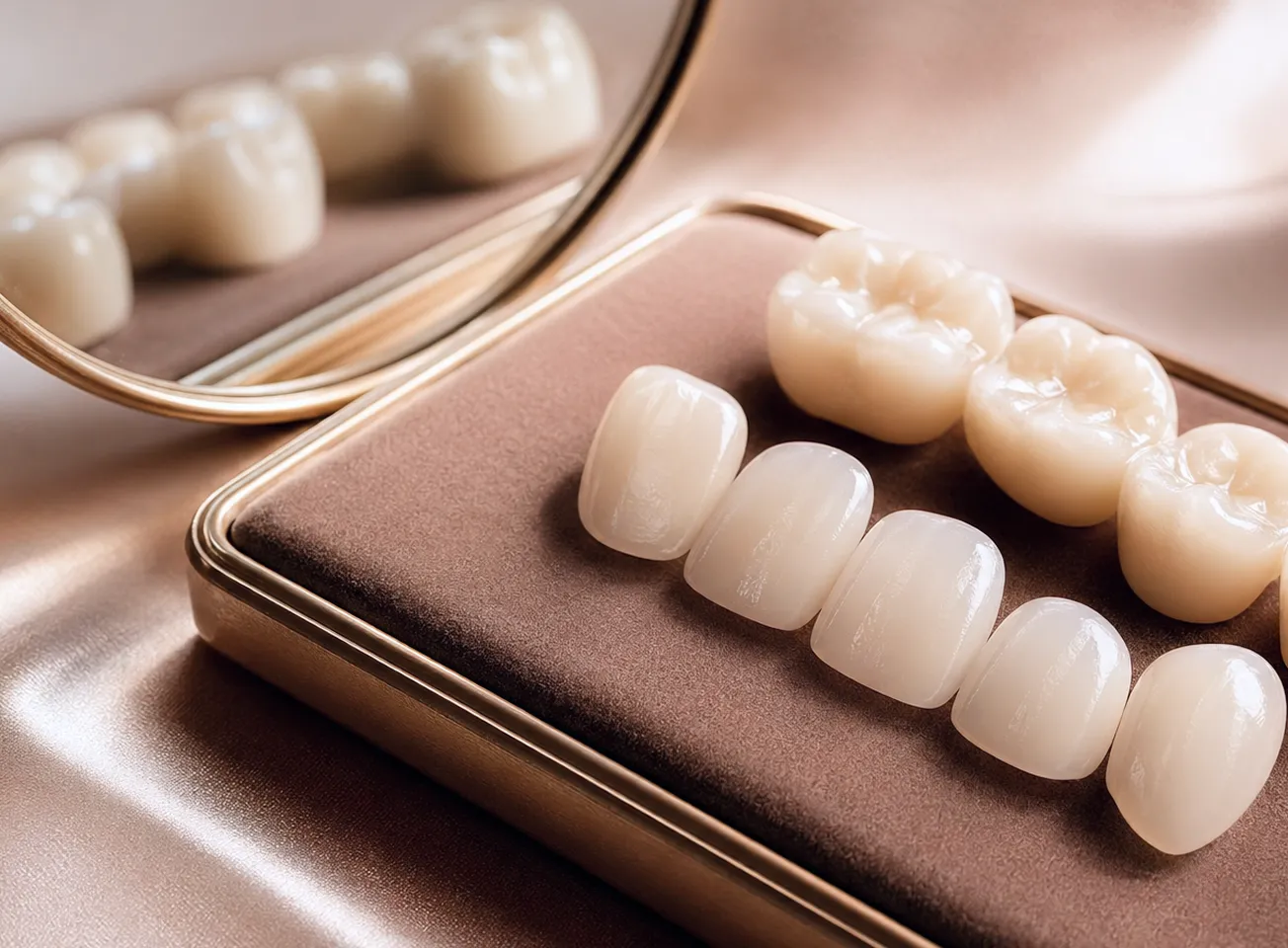
A crown covers the entire tooth above the gumline, typically requiring 1-2 mm of reduction on all surfaces. A veneer covers only the front surface of the tooth, with minimal or no enamel removal when the tooth is already well-positioned. An overlay covers the biting surface and one or more cusps - it sits between a filling and a crown in terms of how much tooth it covers. None of these is universally "more aggressive." Each removes what the geometry of the situation requires, and no more. The goal is always to restore function and form while preserving as much healthy tissue as the mechanics allow.
The Five Mechanical Factors That Drive the Decision
- Tooth position in the arch - front teeth carry shear forces; back teeth carry compressive and crushing loads
- Remaining enamel - adhesion to enamel is far more reliable than adhesion to dentin; preserving enamel changes the long-term bond prognosis entirely
- Bite load pattern - people who grind their teeth, have a deep bite, or have chipped teeth before face material failure at loads that the same ceramic would survive in lighter occlusion
- Opposing surface - ceramic against ceramic wears differently from ceramic against natural enamel; the pairing matters as much as the material itself
- Shape of the prepared tooth - walls that are too straight or too tapered affect how the crown sits and seals, and the problem shows only years later
Ceramic Types and What They Are Designed For
Lithium disilicate (e.max) is highly translucent and bonds adhesively - it performs best when enamel is present and the tooth is not under extreme lateral load. Zirconia is opaque, extremely strong, and tolerant of conventional cement - suited to back teeth, people who grind their teeth, and cases where enamel has been lost. Composite overlays are conservative and repairable, appropriate for medium-load restorations where preservation of tooth structure is the priority. Shade, translucency, and layering technique are decided later. The material comes first - chosen for what the bite and the tooth demand.
When a patient asks for veneers, we look at the bite first. The material that holds up under their specific load pattern is the starting point - not the shade guide.
— MedPalm Clinical Team
When Minimal Preparation Is Still the Right Choice
Minimal preparation - or no preparation at all - is not a shortcut. It is clinically appropriate when the tooth is positioned correctly, enamel is present and sound, and the bite does not place shear forces on the front surface. In those cases, a thin ceramic bonded directly to enamel can achieve a bond strength that exceeds the adhesion of conventionally cemented crowns. Attempting the same approach on a back tooth in someone who grinds their teeth, or on a tooth with extensive wear, tends to fail - not because ceramic is weak, but because the decision was guided by what looked minimal rather than what the mechanics required.
Crown, Veneer, or Overlay?
Start with bite analysis - not a shade selection.
Indicative Starting Prices
For Ceramic Restorations at MedPalm Dental
Porcelain Crown (E.max / Ceramic)
High-strength all-ceramic crown for natural appearance and durability
AED 6 000
Porcelain Veneer
Natural-looking ceramic smile restoration
AED 6 000
Onlay – Porcelain/Ceramic (4+ surfaces)
Ceramic restoration that covers part of the tooth and protects it
AED 5 500
More to Read
on Restorative